Our Blog

June is National Smile Month: Show off your smile!

June 5th, 2019

The community health awareness group Oral Health America has reported that 82 percent of adults are unaware of the role that infectious bacteria can play in tooth decay or cavities, and almost three out of five children aged 12 to 19 have tooth decay. Since June is National Smile Month, Dr. Priscila Denny and our team at Oak Mountain Orthodontics thought we’d remind our patients about the importance of good oral hygiene visits between office visits.

To keep your family’s smiles healthy and beautiful for years to come, be sure to:

  • Brush at least twice a day with fluoride toothpaste
  • Floss every day to clean between your teeth
  • Eat a healthy, well-balanced diet
  • Reduce your intake of sugary foods and drinks
  • Visit Dr. Priscila Denny for scheduled appointments

If you want to know more about healthy home care habits, feel free to ask our team at your next appointment, or ask us on Facebook!


Should I use a water pick during my treatment?

May 29th, 2019

Dr. Priscila Denny and our team at Oak Mountain Orthodontics know that for some of our patients wearing braces, it can be difficult to weave through those wires and brackets as you brush and floss during your treatment.

Some of our patients use a water pick to flush out food and other particles and bacteria stuck between their teeth as the water can reach behind the metal wires and hit spots where your floss simply cannot reach. People suffering from gum disease also find water picks quite effective because of their ability to flush out bacteria from inside the deep pockets.

Water picks are friendly to braces and are also gentle on the gums. They are less likely to cause bleeding for people with sensitive teeth or gums. But as many benefits as they may have, Dr. Priscila Denny and our team want you to know that water picks should never be used as a substitute for flossing. Though they are great tools for helping improve oral health while you are in treatment, they are just not a good enough tool on their own to keep your mouth and gums gingivitis- and decay-free. Water picks are also incapable of removing plaque from teeth as effectively as floss can. While water picks rinse the sticky bacteria off your teeth, flossing is actually more effective as it actually scrapes the bacteria off of your pearly whites.

If you have any questions about water picks or any general questions or concerns about your orthodontic treatment, we encourage you to please ask us below or give us a call!

Caring for Your Smile after Invisalign® Treatment

May 22nd, 2019

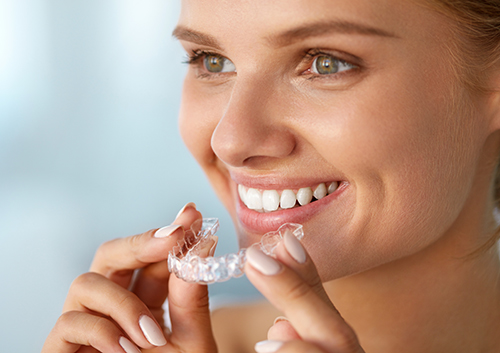
You went through a lot of effort and work to achieve your perfect smile. You wore your Invisalign aligner trays, brushed and flossed diligently, and now your treatment is done! What happens now?

In order to keep your teeth healthy and beautiful, you should keep several practices in play.

Retainers

Although everyone’s needs are different, many patients require a retainer after Invisalign treatment. If a retainer is recommended by Dr. Priscila Denny, use it as directed. Not wearing retainers could result in shifting teeth and potentially ruin your results.

It’s also recommended that you avoid hard, crunchy foods for the first few weeks as your teeth adjust. For younger patients, retainers are normally worn until the wisdom teeth come in or are extracted.

Brushing and Flossing

It should come as no surprise that flossing should still be done every day to remove plaque, which can develop into tartar or calculus. The build-up can lead to gingivitis and gum disease.

Your gums may be more sensitive for a week or two after your orthodontic work is completed. A warm saltwater rinse may relieve discomfort.

Because your teeth have been protected by your Invisalign aligners and are now fully exposed, they may be more sensitive the first few weeks after treatment. If that’s the case, we can recommend a sensitive toothpaste to relieve your discomfort. If your teeth are stained, a professional whitening treatment may be considered.

Regular Dental Checkups

Regular dental exams ensure your teeth stay healthy for life. Professional cleanings, X-rays, and cavity treatment can be addressed by staying on top of your routine checkups.

If you have any questions about how to care for your teeth after your Invisalign program, please ask our Birmingham or Helena, AL team. We want you to keep your healthy smile and enjoy the results of your Invisalign treatment.

Generic Clear Aligners vs. Invisalign®

May 15th, 2019

You may have a talent for home repairs. You may be able to rebuild your computer. You may even be able to put together a whole room of furniture armed only with flat-box kits and an Allen wrench. But, please—don’t try do-it-yourself orthodontics!

Now that generic clear aligners are available, you might consider giving them a try to save some money. But is straightening your own teeth really a good idea? Before you are tempted, let’s look more closely at the products and the dental science involved.

Invisalign®

  • Invisalign clear aligners are used by orthodontists and dentists with experience in custom treatment for your smile. A 3D image of your teeth will be captured by the iTero Element® scanner. Using special software, your doctor can map out each projected shift in your teeth, and even show you a projection of your finished smile!
  • Your Invisalign aligners will be tailored to fit your teeth precisely using the 3D scan and 3D printing. They are made from SmartTrack® material, a product specifically engineered for a perfect, comfortable fit. Invisalign aligners are even trimmed to fit your individual gumline to prevent irritation.
  • When your first sets of Invisalign aligners arrive at our Birmingham or Helena, AL office, Dr. Priscila Denny will check for fit, answer any questions you might have about use and care, and let you know what to look for and what to expect. Your progress will be monitored with visits every six to eight weeks. (And for parents of teens, Invisalign aligners can offer blue “compliance indicators” to let you know they are being worn the 20-22 hours a day necessary for the best and fastest results.)

Generic Aligners

  • You might be required to make a putty mold of your own upper and lower teeth, which is not the easiest thing to do well, and to take selfies of your teeth.
  • The aligners will be sent to you in the mail. They are generally made of hard plastic with generic gumlines. There will be no one to tell you if the aligners fit properly.
  • They are sometimes less expensive because there is no in-person medical supervision. A dental professional working for the company will look at the model created from molds you submit, and recommend a series of aligners to correct the problems he detects by looking at the model and your selfies. This supervisor will not be able to assess the overall dental health of each patient to make sure teeth and gums are healthy and ready to start treatment, and will not be able to tell if the teeth are moving properly or improperly once the aligners are in use.

Finally, while generic aligners may potentially have some success in minor tooth straightening, they are not created to deal with complex bite issues or malocclusions.  In fact, using generic aligners with no supervision can cause more serious dental problems than a patient started with.

Sure, sometimes a do-it-yourself project turns out well. But your teeth and bones are too important for home improvement. When it comes to creating a beautiful, even smile and balanced, comfortable bite while making sure of your dental health, it’s always best to trust a professional like Dr. Priscila Denny to provide you with gentle, tested, and successful care!

Contact Us!
call email